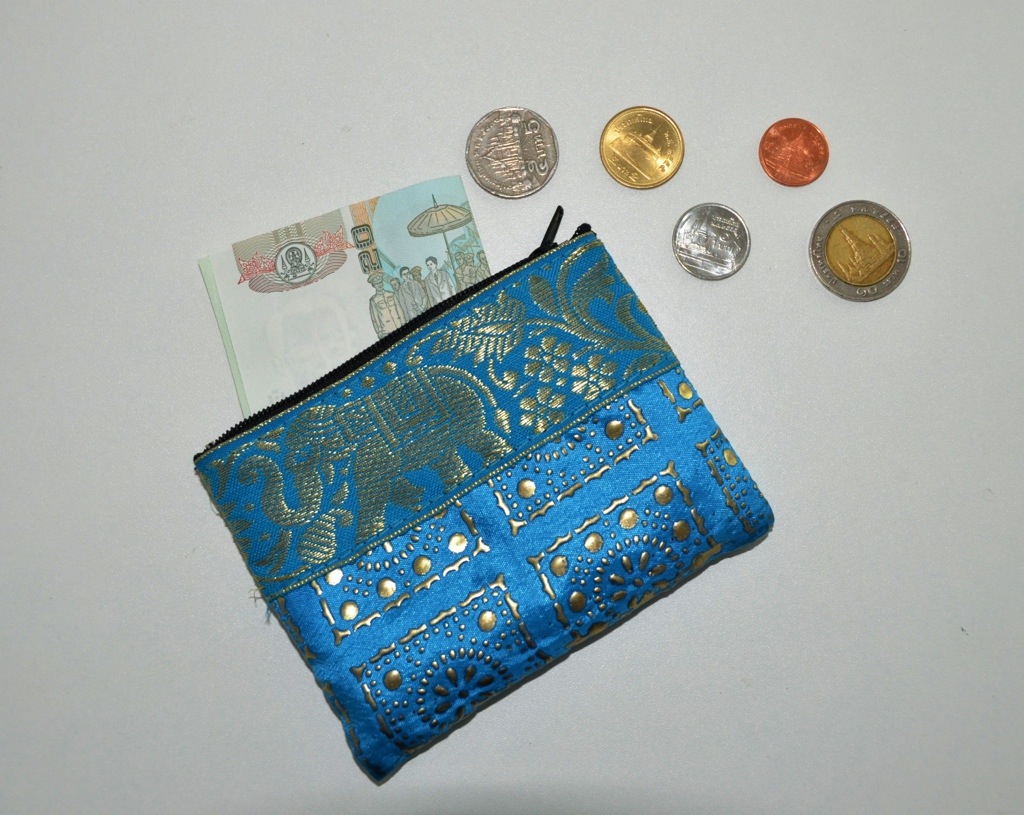
It only took a day or two in Thailand and a few baht bills later to realize that we took for granted the convenience of using a debit or credit card for everyday purchases. Back in the States, we used to simply whip out a debit or credit card and make a purchase with one, smooth swipe. Not only is it physically easier to use a card than it is to use cash, it was just more convenient for us to have access to our money electronically than to have cold, hard cash.
The Many Shapes and Colors of the Thai Baht
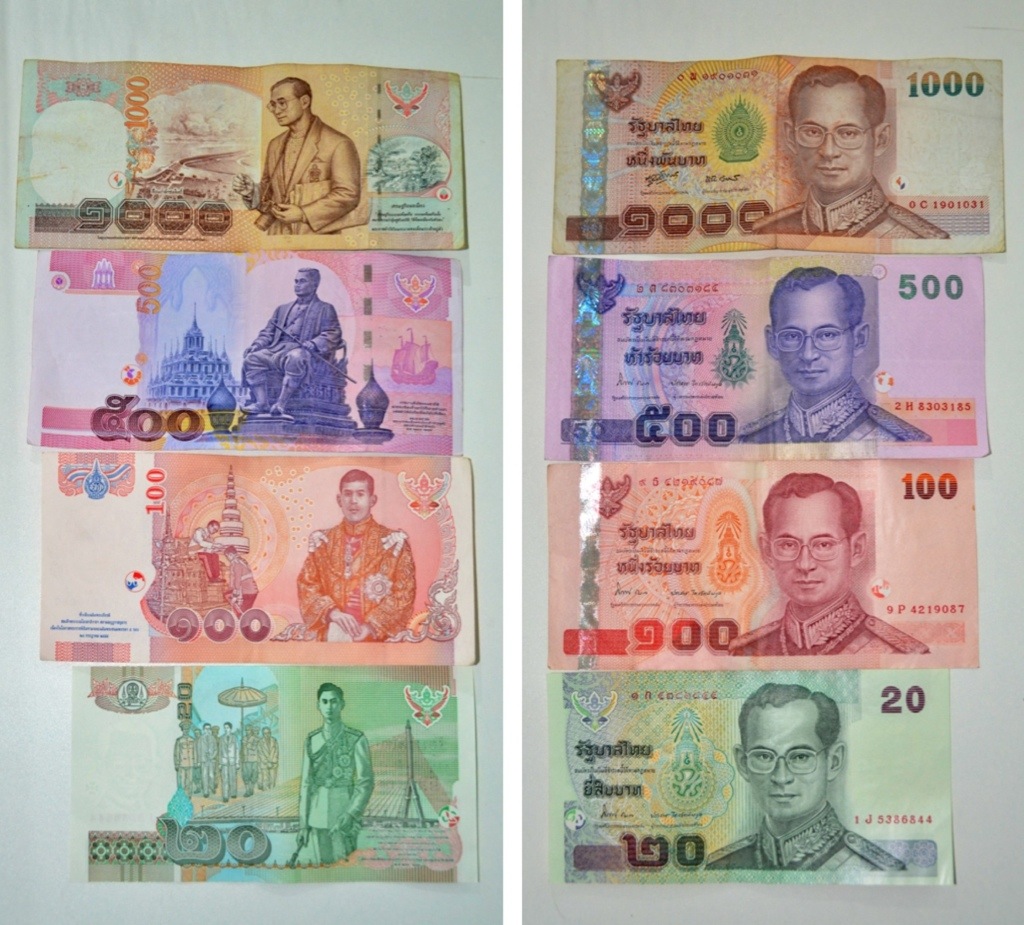
Pictured above is the front and back of most Thai bills (missing the 50 baht bill). Each bill and coin has a portrait of His Majesty, The King.
Here in Thailand, we find ourselves paying in cash because that is the only option accepted, at least when we buy food at the market or the street stalls. What’s the problem with paying in cash? At first, we had a hard time actually handling the money, as we often fumbled over the Thai baht bills. It was so strange to be touching it, counting it, organizing it numerically, and then straightening it up before tucking it back in our wallets. On top of that, we (still) have to simultaneously convert numbers in our heads when given the final price, and then we have to do math to double check our change. Using cash certainly takes more brain power!
Oh and coins? We forgot how awkward they are to carry around. We’ve figured out that it works well if I carry a separate little pouch where we put the change, rather than keep change in Chris’s wallet.
Coins come in 1, 2, 5, and 10 baht. There is also a fifty-satang (small, copper-colored one), which is equal to half a baht.
And did I mention that cash runs out? That means we have to go to the ATM every few days. We are actually forced to budget and be more aware of what cash we physically have on us. We’ve since gotten used to handling money, but it was just one of those little things we weren’t expecting!
Hello Chris and Angela,
First and foremost – THANK YOU for being so informative, forthcoming and open about your experiences. I am planning a permanent move there myself in a year and I am CERTAIN I wouldn’t be able to without a website this supportive.
Second, This article! I’ve been trying to figure out how much I need to budget for currency exchange alone each month and am so happy you guys covered this topic. You, literally, have left no stone unturned and I’m not even half way through all of the articles.
Third, I would like a bit more clarification on a particular topic (possibly continued reassurement), if you don’t mind, as I am trying to over-budget as you two suggested in a previous post. Should I set aside a monthly allowance just for currency exchange fees (be it ATM or otherwise)? If so… How much would you suggest for a 2k monthly budget (again, over budgeting just in case I’m not a tough as I think I am re: certain local conditions)? If there ANY way around these fees as a US Foreigner? You gave the most Godly advice re: the tip on Charles Schwab that I will research next week,… I definitely don’t want to be charged for using my money if I don’t have to… but if you have since discovered a loophole that avoids foreign bank wire, ATM, etc. rates… pretty please do share. I’m also super open to any suggestions, or links to other articles you may have, re: how often you transfer money, etc. Again, Money is a sensitive topic, but it’s the most important topic as without it, or taking secure measures in handling it, I will be across the world without protection.
Sorry so long, THANK YOU SO MUCH. I hope you two are doing amazing! – Star
Hi Star! Your compliments are music to our ears. We’re glad our site has become such an integral part of your planning process to move to Thailand.
We personally don’t set aside an alotted budget for foreign currency fees because we access our money through Charles Schwab. It’s our saving grace – all fees are refunded back to us at the end of the month. Absolutely sign up! We take out money 2 or 3 times per month (that would usually be 6.50 USD ATM fee plus American bank fee plus any currency conversion fee) but it’s all free :).
Another alternative is to connect your current bank with Bangkok Bank (New York branch). It’s a workaround if Charles Scwab falls through. Although there used to be a fee-free wire transfer loophole (if we remember correctly) its transfer fees are the
lowest we’ve come across. For example, transfering anything between 2k-50k USD incurs a 10 USD fee. So if anything, your budget would be 10 USD on your 2k stipend.
We want to apologize for such a late response. Your message got buried (sorry!) but we hope this helps. Let us know if you have any other questions. Have a good one!
That is strange… Here in Bangkok, if I withdraw cash using a Bank’s (let’s say Bangkok Bank) ATM card on a Bangkok Bank ATM machine, there’s no withdrawal fee. It is the same as other banks.
You’ll only be charged a fee if you use something like a credit card to withdraw cash from an ATM machine.
Maybe I misunderstand your posts?
Yes, you’re right on both accounts. We are charged a foreign transaction fee plus ATM fee when we’ve used our foreign debit and credit cards in Thailand.
On the bright side, at least Thailand doesn’t use a decimal system. Makes it a bit easier carrying coins when you don’t have to worry about anything smaller than a baht!
Every once in awhile we’ll see two smaller coins – twenty-five satang and fifty satang (quarter baht and half baht). Both are copper colored and pretty tiny, but they are rarely used. We’ve never used them in the market, but once in a blue moon we’ll receive them as change at a 7-11.
The other thing about cash over here? It (generally) costs money to get it if you’re a foreigner. Apart from the AEON ATM’s which don’t charge, everyone other bank’s ATM charges you 150 Baht for every withdrawal, and typically limits them to 25,000 Baht max (effectively a 0.6% surcharge) – for smaller withdrawals, that surcharge becomes an even higher percentage.
Very true, Kevin. We use a Charles Schwab checking account that refunds those 150 baht fees every month and we aren’t charged foreign transaction fees either. Unfortunately, I think these accounts are only open to Americans. AEON banks are a nice option, but unfortunately they are few a far between. We really appreciate the input.